Dr. Gymbro
←

#time trial

2 articles
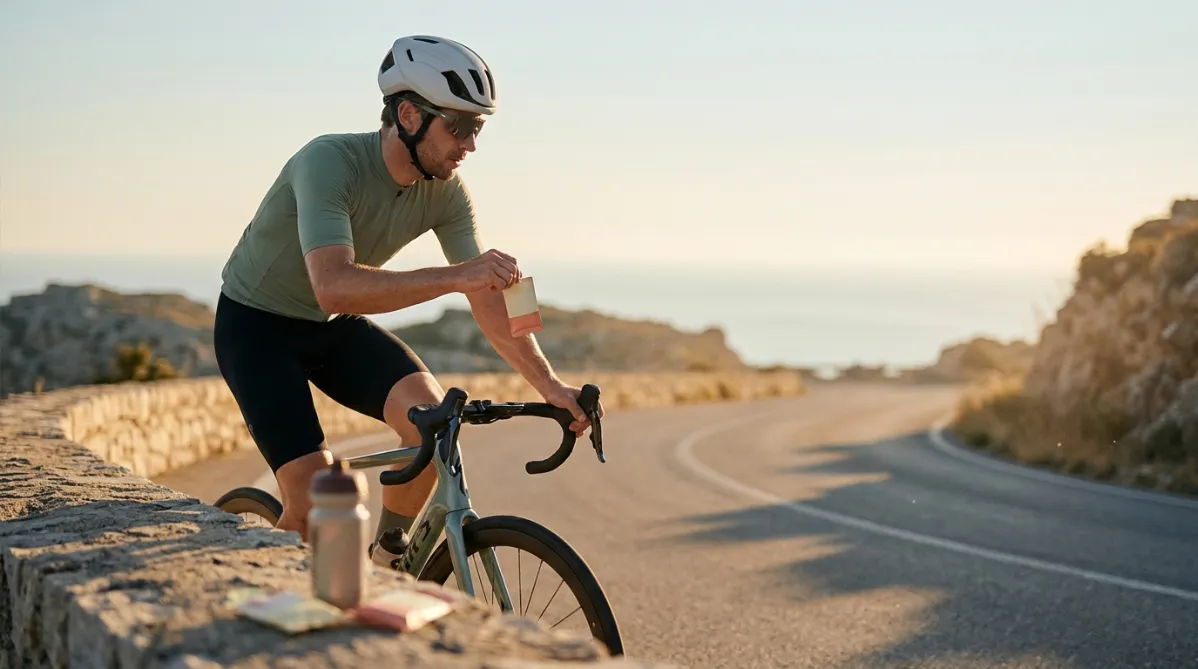
A cyclist in profile, riding a sleek road bike along a quiet coastal road in warm golden-hour light, shot from a low side angle with a shallow depth of field. The rider wears a muted sage-green jersey, black bib shorts, a matte white helmet, and sunglasses. Their face shows calm, focused fatigue, with a faint sheen of sweat on the forearms. One hand is lifted slightly from the handlebars, holding a small, unbranded matte gel packet in soft cream and coral tones, just before opening it. The road curves gently behind them toward a hazy, softly blurred horizon of pale sea and distant hills, with long amber shadows stretching across the asphalt.

In the foreground, slightly out of focus, a few gel sachets and a bike bottle rest on a weathered stone wall at the left edge of the frame, adding editorial depth. Fine dust and sunlight glow in the air. The palette is warm and restrained: butter yellow, soft peach, sage, and slate blue, with gentle film-like grain. The composition leaves open negative space in the upper right, a pale gradient sky, for headline overlay. The overall look is a modern, minimalist sports-science magazine photograph: natural, premium, and clean, with realistic textures, cinematic but understated color grading, and no text, logos, or graphics.
nutrition

Bicarb‑gels halverwege de rit: +12 W later in een 3‑uur fietstest

BY DR. GYMBRO ·

Stel je voor dat het beste moment om bicarb in te nemen niet vóór de wedstrijd, maar tijdens de rit is. In een nieuw gerandomiseerd crossover‑onderzoek met 11 getrainde wielrenners werd een bicarb‑plus‑koolhydraatgel gedurende drie uur fietsen getest. In de vermoeide toestand na de rit leverde een 12‑minuten tijdrit 12 W meer vermogen op dan alleen koolhydraten, terwijl maagklachten gelijk waren. Sprints en 2‑minuten‑inspanningen toonden echter geen significante winst, de steekproef was klein en de producten werden geleverd door MNSTRY. Hier lees je wat de cijfers écht zeggen.
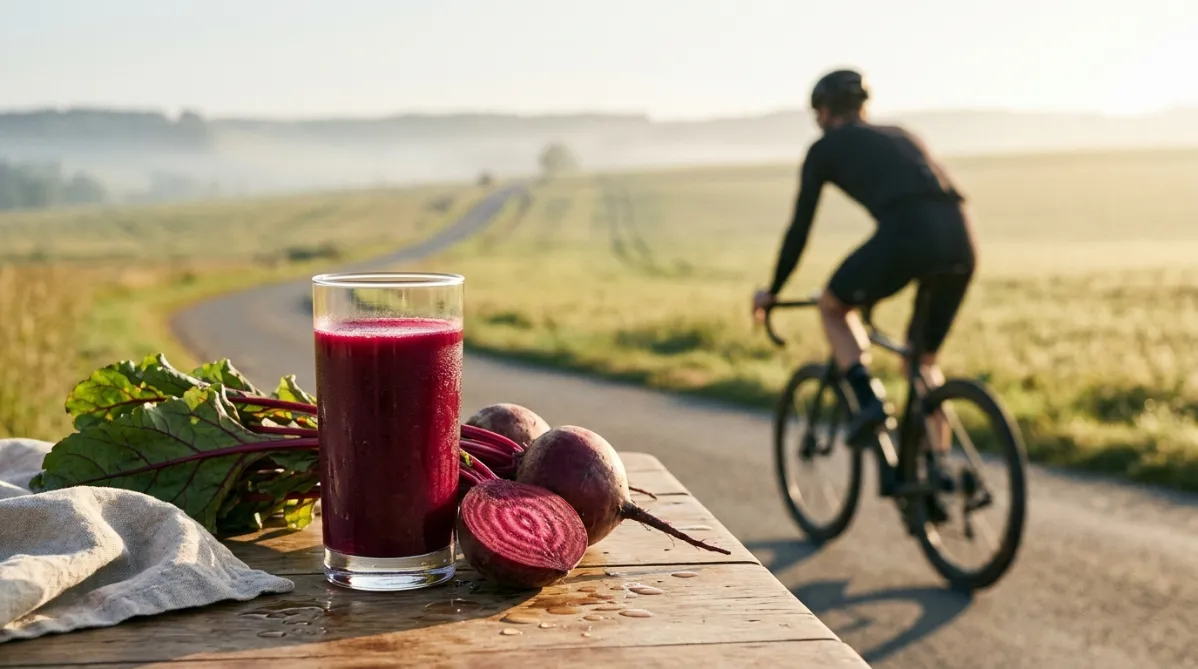
A cyclist in a fitted matte-black kit, shot from a low three-quarter angle, rides a sunlit country road at early morning, slightly out of focus with soft motion blur on the wheels. In the foreground on the left sits a rustic wooden table with a tall glass of deep magenta beetroot juice. Condensation beads on the glass, and the light catches its vivid jewel-toned color. Beside it lie two whole beetroots with their leafy red-veined greens still attached, and one halved beet shows concentric crimson-and-pink rings. A small linen napkin and a scatter of water droplets add an editorial still-life feel.

The background is a gently rolling landscape with golden-green fields and a thin ribbon of asphalt curving toward the horizon. Pale mist hangs low and warm sunlight comes from the right, creating long soft shadows and a golden rim light on the glass and the cyclist's silhouette. The shallow depth of field keeps the juice and beets crisp while the rider stays a dreamy blurred suggestion of speed.

The palette is rich magenta, burgundy, warm cream, sage green, and soft gold, with muted, slightly desaturated tones in the background so the beetroot color stands out. The composition follows the rule of thirds, with the still-life in the lower left third and open negative space in the upper right for the title. The overall look is a clean, modern lifestyle-magazine photograph with natural film-like grain, calm and athletic, and no text, logos, or futuristic elements.
nutrition

Bietensap voor een tijdrit: hoe 0,5 L de 4‑km‑ en 16,1‑km‑tijden verkort met bijna 3 %

BY DR. GYMBRO ·

Een kleine, maar invloedrijke crossover‑studie uit 2011 onderzocht of één enkele portie bietensap een tijdrit kan versnellen. Negen competitieve mannelijke wielrenners dronken 0,5 L nitraatrijk sap (≈ 6,2 mmol nitraat) ongeveer 2,5 uur voor de start. De plasma‑nitrietconcentratie verdubbelde, het gemiddelde vermogen steeg en de 4‑km‑ en 16,1‑km‑tijden verbeterden respectievelijk met 2,8 % en 2,7 %. Het zuurstofverbruik bleef gelijk, wat wijst op een betere fietseconomie in plaats van een krachtigere aerobe motor.

This page is available in